“What the heck is that?”
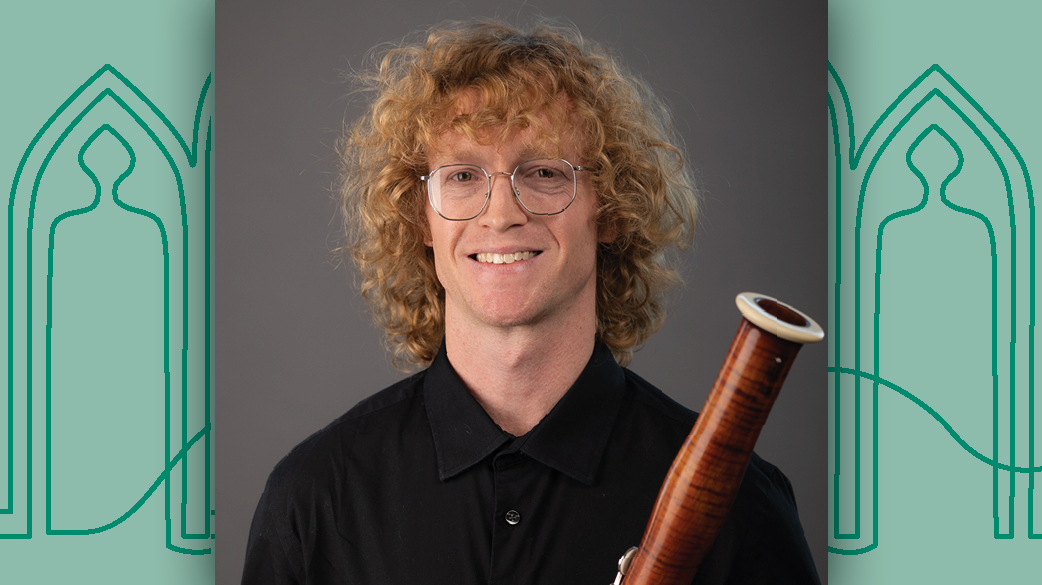
That was Taylor Shorey’s response as a young high schooler, when his band director first brought up the bassoon. Up to that point, he’d never heard of one. A saxophone player, Shorey had his eye on the oboe for a switch from sax, but the band already had a couple of good oboe players. Why not try the bassoon?
Shorey took home recordings of the double reed woodwind and if not love at first listen, it came close. “I listened to a bunch of recordings and sort of just fell in love with the sound of it.” It’s a quirky looking instrument, with a rich and highly expressive musical range.
As Mississippi Symphony Orchestra’s Principal Bassoon, Shorey will show off all of that as the featured artist in two Vivaldi bassoon concertos at Beloved Baroque, MSO’s first Chamber concert of its remarkable 81st season, on September 6 at St. Andrew’s Episcopal Cathedral in downtown Jackson. Also on the program: Vivaldi’s Concerto for Strings; Corellis’s Concerto Grosso, and Bach’s Orchestral Suite No. 2.
Shorey originally hails from Florida’s Fort Lauderdale-Miami area, where his mother’s role as an elementary school music teacher served up his first introduction to classical music. “I saw one of my mom’s students playing the violin at the talent show, and you know, I just had to play it,” he said. “I apparently bugged her all the time about it when I was 4 or 5 years old.”
Music trickles through his family tree, too. “I had a great grandma who was almost involved in music, but then she had five kids.” She was a singer, as is his mother, but Shorey became the first instrumental musician in the family, playing violin up to age 18, and focusing more on bassoon through college.
The camaraderie and community he found in musical pursuits pulled him into its circle. “That’s where I made all my friends in high school… with marching band…. The community aspect of that, I think, is what really made me want to make a life doing it.”
His goal in high school was to be the loudest bassoonist possible. “All my friends told me they could never hear the bassoon, so I wanted to be the one that they could actually hear.”
The bassoon remains one of the lesser-known instruments in the orchestra. “Even still today, I’ll tell people what I do, and most often the answer is, ‘What the heck is a bassoon?’” When he did a stint as an Uber and Lyft driver, Shorey eventually wound up telling riders he was a saxophone player, just to dodge the lengthy explanation.
But he sees the bassoon gaining ground. Oboe and bassoon are popular “scholarship” instruments, he said, with band directors pushing talented young musicians in that direction in the quest for a college scholarship.
“For that reason, I do think, especially among my generation where college has gotten so expensive, it’s become a very competitive instrument. There’s a lot more people playing it, which is cool because it makes the community more exciting.” The bassoon took him on a full ride scholarship to Florida State University and other degrees, too, at low to no cost, he said — FSU bachelor’s in music, Colburn School Professional Studies Certificate and University of Cincinnati College-Conservatory of Music (CCM) Artist Diploma. Career highlights include his selection as a finalist (and only American) in the International Double Reed Society 2024 Fernand-Gillet-Hugo Fox Competition for Bassoon and first prize recipient in the William Winstead Prize for Artistry in Wind Playing at CCM.
The start of Shorey’s third season with MSO sees him centerstage in the Beloved Baroque concert, kicking off what’s hailed as a “Season of Genius.” “It’s my first time as a genius,” he quipped. He described the spotlight role as pretty exciting, and a little intimidating. But solo playing is one of his passions. “We always get a good turnout for the Baroque concerts, so I’m sure it’s going to be a blast.”
It’s a prime chance to showcase the full-fledged personality of an instrument that’s sometimes dubbed the “clown of the orchestra,” with its bizarre look and reputation for comical sounds.
“The thing that’s surprising to most people is how vocal it is,” he said of the bassoon. “Bassoonists tend to use a lot of vibrato, like a vocalist would.” It can be deep and longing or bouncy and exuberant. “The cool thing about this concert that I’ll be doing is, you’ll get to hear a little bit of both. There’s kind of the goofy side of the bassoon, and then there’s the really lyrical, mournful longing kind of bassoon sound.”
Shorey praised the way Vivaldi, at a time music was more formulaic, wrested so much personality from that structure. “There’s really a lot of excitement and intrigue,” he said. “You could tell he was particularly fascinated by the bassoon because, next to the violin, it’s actually what he wrote the second most concertos for.” The freedom to add your own flair — the ornamentation characteristic of Baroque music — is another fun point.
“Everybody will have different ideas of where to fill in with extra passages, extra lyrical lines. You get a little bit of freedom to experiment and put your own flavor in it,” said Shorey.
“I don’t like to be bound by conventions too much,” he continued. “I like to have my own performance. I don’t want to sound like a bassoonist did in the 1700s necessarily. I like to always try to bring something new and different or maybe show off different notes that the bassoon can play now,” including ornaments or embellishments with high notes that weren’t even available to bassoonists back then.
“My approach to playing is just that I want to make it exciting, right? At whatever the cost.”