
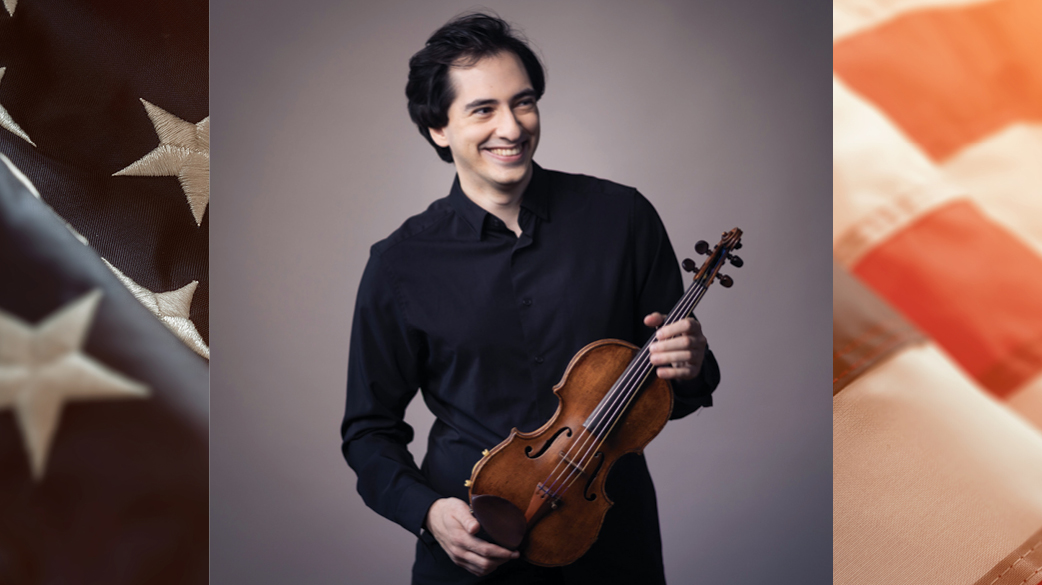
Young international prize-winning violinist Basil Alter will make his Mississippi Symphony Orchestra debut as guest soloist in the upcoming “American Celebration” concert on October 10.
His appearance is a welcome return to the American South from which he hails and marks his first collaboration with MSO Conductor Crafton Beck, who made early career recommendations for the young talent.
Alter’s performance of Samuel Barber’s Violin Concerto will be the centerpiece of this all-American program which also features Leonard Bernstein’s irresistible Candide Overture and William Schuman’s bold and vivid Symphony No. 3.
For Memphis-born Alter, the musical seeds were planted early, in a combination of genes and surroundings that seemed to channel him toward the concert stage.
“I think I always knew that I’d be doing something musical,” said the recent Royal Academy of Music graduate now based in London.
His is a musical family. “My father’s a clarinetist and my mom is a violinist. My sister was a violinist and still plays occasionally.… Always some music going on” he said of the home front – mostly classical, and sometimes jazz, which his parents love. Different kinds of music folded into the mix, too, and he kept an open mind from a young age.
When he was three, his mother started him on the violin. “We weren’t doing anything terribly, terribly serious, but it was always great to be playing. I enjoyed it,” he said.
Alter played a lot of instruments – piano and more – when he was younger. “Eventually, violin won out. There’s something very special about this instrument, and the way it works and the way it can make music, and all the different intricacies that it’s got.”
The violin, he said, would always be “the rock of everything.”
A musician’s life is not an easy road, and his parents did not foist expectations on him or his older sister, he said. But “I knew that I wanted to play. Ultimately, there was just no question that this is what I wanted to be doing.”
When Alter wanted to move from Memphis to New York, Conductor Beck provided some key connections. “There are a couple of people in particular that, based on his recommendation, were willing to help me out,” Alter said.
Even a decade ago, when the violinist was still a teen, Beck was impressed by what he heard. “I really believe he’s brilliant. He’s as talented as he can be, and so musical,” Beck said. “I like to think I’ve played some role in supporting him.”
Alter graduated from the Manhattan School of Music, where he led the orchestra on several occasions and won the school’s chamber music prize. At the Royal Academy of Music in London, he worked alongside figureheads of the UK music scene including Tasmin Little, pursued a highly commended project on the violin works of Stravinsky and led the Academy orchestra in their Aldeburgh Festival appearance. He is currently an artist for the Tillett Trust, the City Music Foundation and the Hattori Foundation.
Alter and Beck stayed in touch. “He said, ‘Well, sometime maybe you should come down and do something,” Alter recalled, “and I said, ‘Well, that’d be nice.’ Stars aligned for Barber.”
A major, celebrated composer of American classical music of the 20th century, Barber composed a violin concerto that became the country’s most popular and beloved.
“It’s a piece I’ve known forever,” Alter said, “and it’s one of the most important pieces of violin music in the 20th century.” The 1939 work, with its lush first two movements and fiery finale, premiered in Philadelphia, and “It’s got that sort of feeling to it,” Alter said.
“It’s somewhat of a patriotic piece,” he added. “I think all music, in some ways, is a reflection of the society that you’re living in, right?”
In it, hear optimism, serenity and deep beauty and meaning. It has intention. “I don’t think there’s any wasted moment.” Another quality Alter noted: steel. It feels direct and to the point.
He is grateful and eager to be able to share all that with Jackson listeners in his first time with the Mississippi Symphony Orchestra. “I’m really, really, really looking forward to coming down.
“I’m not from Jackson,” he conceded with a chuckle, “but, you know, close enough.”