
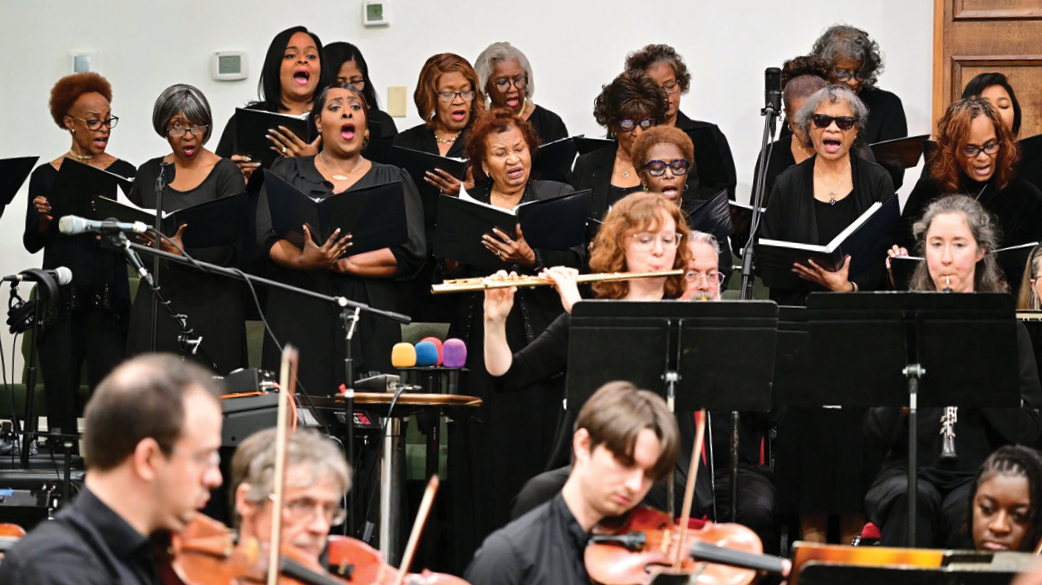
Mississippi Symphony Orchestra’s November 22 matinee at Cade Chapel Missionary Baptist Church in Jackson bursts with “Spirited Jubilation.” It’s a fitting title and outlook for a concert that salutes the 250th birthday of United States, celebrates Margaret Walker’s poetry in new ways and concludes with Gloria from Gospel Mass by Robert Ray.
In a way, each of these parallel the driving spirit behind MSO’s innovative collaboration with Cade Chapel, now in its fourth year – performing music from the classical canon alongside music from the Black church to open insights, inspire conversation and forge connections in community.
“So often, we rest on believing a particular community only sings a particular type of music, and that community only sings that particular type of music,” said JSU Director of Choral Activities and Cade Chapel Minister of Music Harry Cecil. “The marriage of MSO with Cade Chapel has broken that trope in a significant way.”
Cade Chapel traditionally presents music of the Black church, such as gospel, up-tempo Christian music and gospel hymns. MSO’s traditional lane is mostly Western European composers and classics. Their “dynamic” collaboration, Cecil said, “allows us to show the world and show the community this doesn’t have to be the case, just because that’s the way it has always been done. The partnership allows us to sing music that bridges the gap… and everything in-between.
“It’s a great demonstration that music is global,” Cecil said. Inclusive, too. “It’s a brilliant way of showing that music is for everyone.”
The matinee opens with Aaron Copland’s Appalachian Spring performed in its original version for a chamber ensemble of 13 players. Songs of Margaret Walker poems – I Hear a Rumbling and I Want to Write – are at the heart of the program, performed by the JSU Concert Chorale. The concert finale is Gloria performed by the combined voices of the JSU Concert Chorale and the Cade Chapel Chorale.
This performance of Walker’s poetry draws from recent concert premieres of Randy Klein’s opera Jubilee: A Folk Opera adapted from the writer’s landmark novel Jubilee about her grandmother’s and great-grandmother’s journey from slavery to freedom.
At Cade Chapel with a smaller choir and more artistic expression from the orchestra, “It’s going to be just as dynamic, just as impactful, just as inventive” as in the Jubilee concert premieres, Cecil said. “Students who performed in Jubilee will feel like they’re singing something very fresh and new with Crafton Beck’s arrangements.”
“The Jubilee concert performances at JSU and Yale earlier this year represented a key first step toward its development into a full opera with orchestration, costumes, sets and more,” Margaret Walker Center Director Robert Luckett said of a goal that would require significant investment and that could be about five years away. Luckett continued, “The center has been working hand in hand with Klein, dating back 20 years to the musician/composer’s work on the Margaret Walker Song Cycle, and in the last six years as he focused on the folk opera. Pieces from the Song Cycle are now part of the opera.
“Randy envisioned this, almost as a conversation between Margaret Walker (as she’s finishing Jubilee in the 1960s) and her grandmother and great-grandmother (as they live from slavery to freedom), which is the story of Jubilee,” Luckett said. “So, it kind of jumps back and forth between Margaret and the main characters in the story, who are her grandmother and great grandmother, and it juxtaposes the civil rights movement of the 1960s with the experiences of these two Black women, as they’re living through this period of incredible change as well, with Emancipation and Reconstruction.”
Its music and songs stand on their own as beautiful performance pieces, too, and Cade Chapel is particularly fitting setting to share and hear them, as well as honor Walker’s work and her influential role as a writer and educator in Jackson for 49 years.
“Margaret’s faith was always something very important to her, and the story of faith in the Black community, even in the harshest of times, is a theme throughout Jubilee, and what that faith does to lend support in a moment in history where there does not seem like there’s a whole lot of hope for people of African descent in this country,” Luckett said.
The songs and music in “Spirited Jubilation” stand as a testament to ways that collaboration, inspiration and fresh perspectives, once again, move the art forward, opening doors to new creations, new insights, new connections and an ever-broader reach.
Come for the music, stay for the conversation.