
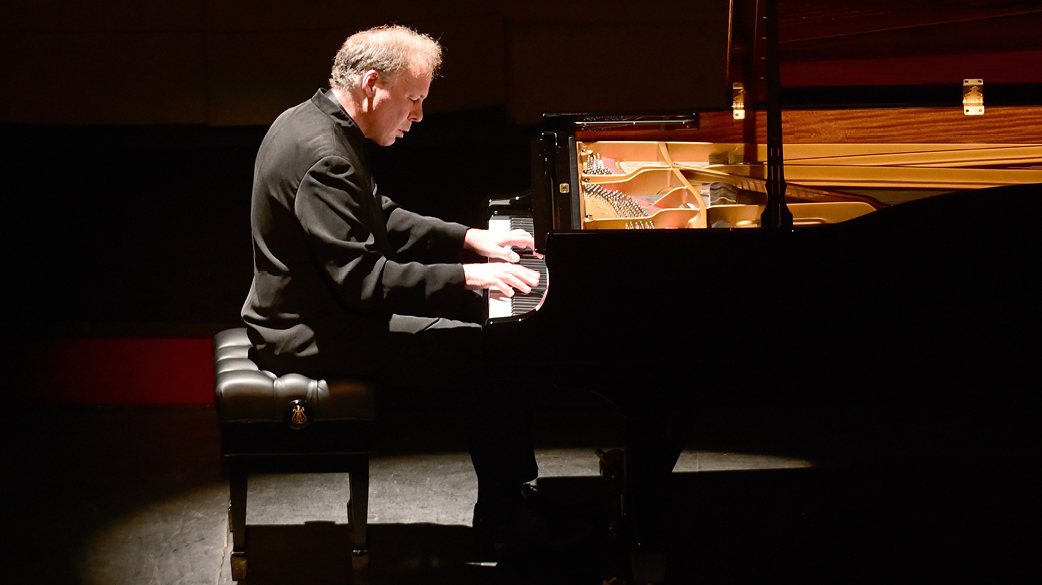
International pianist and local favorite Alon Goldstein returns to Jackson for Mississippi Symphony Orchestra’s April 11 “Mighty Keys” concert at Thalia Mara Hall – an evening that opens with the wit and melodious charm of Sergei Prokofiev’s Lieutenant Kijé Suite and finishes with Johannes Brahms’ epic Piano Concerto No. 1.
Israeli-born Goldstein’s multiple guest appearances, with MSO and in solo recitals here, have won him the affection of capital city music lovers. And that embrace is mutual!
“It’s a home,” Goldstein said fondly of Jackson, by phone from Vienna. With a performance, teaching and directing schedule that keeps him on the road 240 days out of the year, “I call icloud home,” he joked.
But he was serious about Jackson. Goldstein won the Wideman International Piano Competition, in Shreveport in 1996, and is now its artistic director. “One of my favorite people in the world was Lester Senter Wilson, rest in peace and bless her heart. I mean, she’s family,” he said of Wilson, the competition’s executive director 1985-2020 and a driving force in Mississippi’s cultural scene.
“Bravo restaurant is one of my favorites,” he continued. “[Jackson] is a very special place…. It’s something about real America for me, there,” he said. “It’s a privilege to come.”
Goldstein is the featured guest in Johannes Brahms’ Piano Concerto No. 1, an epic piece not only in its length, depth of emotion and place in the classical cannon, but also for its role in his own life. Goldstein’s introduction to it was unforgettable.
“When I was 10 years old (and I was not a prodigy child), I went to a concert… of Zubin Mehta conducting, and Daniel Barenboim was the pianist. Usually, I would fall asleep at a concert,” he confessed. “Not this one. I heard this piece and it changed my life… I’d never heard anything so compelling!”
He bought the LP, he said, “… and I just kept playing it over and over and over and over and over again…. It was always my dream to play it.”
Brahms wrote the piece when he was in his early 30s. Though the concerto suffered in initial reviews, in time people recognized it as one of the greatest piano masterpieces and, clocking in at 50 minutes, among the longest in the standard repertoire.
Goldstein was in his early 30s when he first played it. “The first performance felt like climbing Mount Everest.” He worried he would never finish; it’s so big. “It’s such a human struggle, and the accomplishment at the end is so overwhelming. There is nothing like that.
“It’s one of the greatest works in Western literature, in Western music,” he said. “Brahms was hailed as ‘the composer who will carry the torch from Beethoven to New World.’”
Highly influential German composer, pianist and music critic Robert Schumann was a mentor and friend to Brahms, and his article introducing Brahms to the world launched the young composer’s career. But Schumann, suffering from mental instability, attempted suicide just a few months afterward, said Goldstein.
“The beginning of the Brahms concerto is devastating – so dramatic,” continued Goldstein. “And when people asked Brahms about how dramatic it is, he said, ‘This is what I heard in my head when people told me that Schumann attempted suicide.’”
If its first movement is his relationship with Schumann, the inspiration and the struggle, Goldstein said, then the second focuses on Schumann’s muse and wife, Clara, also an influential pianist of the era.
“She also inspired Brahms very much. So, the second movement is almost like a homage, an almost religious homage to his love for Clara,” Goldstein reflected. Platonic love, but also unrequited love.
“This concerto is all emotions, from first note to last note.
“It is a transformative piece. When you finish it, you are transformed. So, I cannot wait,” declared Goldstein.
He hopes the audience joins him on that journey, emerging as somehow better and more aware. “We are living now in a world which is so confused. And sometimes, it’s good to stop and just see, where am I in relation to that? How can I help…. How can I make us realize we are all in it together, not dividing each other but uniting each other.
“For me, there’s something about music that is unifying.”
And, since he was in Vienna, perhaps there was a homage that he could pay, before heading this way:
“Maybe I will go to Brahms’ grave to say hello before I play the piece.”