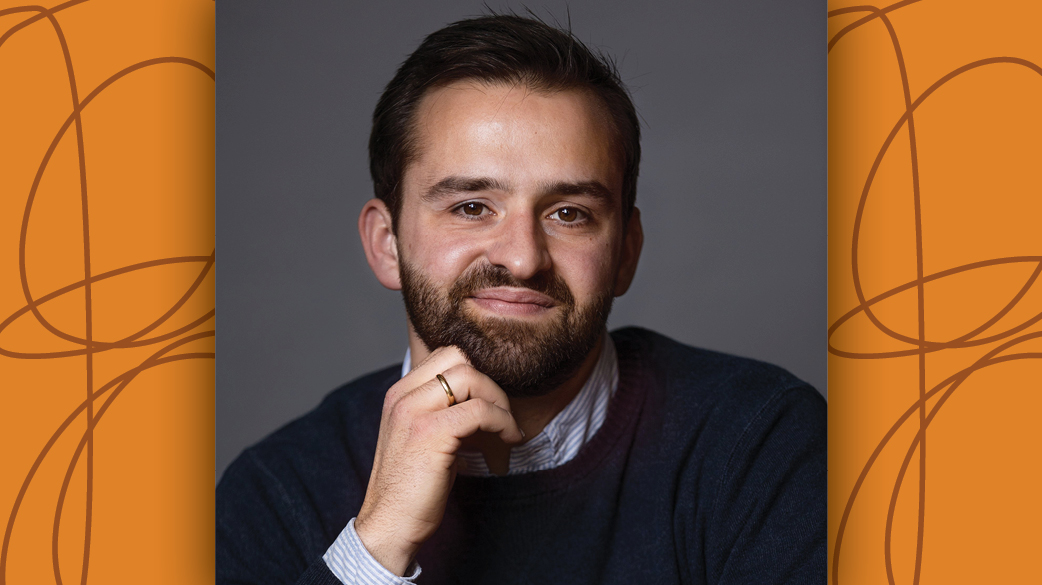
William Hagen returns to the MSO stage in “Ultimate Beethoven” February 28, violin in hand and excitement in his sights.
Ludwig van Beethoven’s solitary Violin Concerto is what he’s bringing – a huge piece, in length, depth, height and more. “It’s really one of the most famous violin concertos, generally regarded as one of the best,” said Hagen, 33, who’s been playing it quite a bit over the past two or three seasons.
“It’s not a piece I played a whole ton in my childhood, but I listened to it [a lot], so it’s a real thrill to be able to play it.”
Hagen, of Salt Lake City, was only nine when he made his debut with the Utah Symphony, following a first prize win at the Utah State Fair. Violin pursuits edged ahead of sports, including studies with Robert Lipsett at the Colburn Community School of Performing Arts and Colburn Conservatory of Music, with Itzhak Perlman and Catherine Cho at the Juilliard School and with Christian Tetzlaff at the Kronberg Academy. His active schedule includes appearances across Europe and the U.S., performing a wide range of repertoire.
Beethoven’s Violin Concerto stands out. “It’s really, really dramatic, and I would say, intensely beautiful,” Hagen shared. “It goes to greater depths and greater heights than other violin concertos.” Not by trying harder, though. “Beethoven doesn’t do that by composing way more notes and way more this and way more that. Instead, it’s the simplicity that I think is most moving.
“There’s something unbelievably profound about it,” he continued. “There are moments in the second movement which, you talk to most violinists and just lots of musicians and they’ll be like, ‘That’s one of the prettiest themes ever written.’
“It’s some of the most moving stuff, I think, in the violin repertoire.” And when Hagen is caught up in the performance, the audience is right there with him. “That’s my job, basically. That’s what I need to do.
“I need to like the piece more than anybody else in the room. I need to be more amazed by that next note. If there’s a surprise, I need to be the most surprised,” he said. “It’s just like an actor. You know the script, but you can’t read the script like ‘Oh yeah, I know this, I memorized it.’ …. You can’t have that attitude or nobody’s going to get into the story.
“So that’s my job, to be like an actor – just totally, totally amazed by every interesting turn and, you know, if I have a sense of wonder publicly, in front of everybody, then hopefully the audience has a sense of wonder, too.”
MSO’s ranks have filled with more young players in recent years, between retirements and new hires. Hagen’s biggest advice for young musicians? Enjoy it. “Classical music is often seen as an academic pursuit…. If somebody were to say, ‘Yeah, I’m going to garage band practice, people might roll their eyes more than if they say, ‘I’m gonna go practice the piano’ or ‘I’m gonna go practice the violin.’
“Garage band is seen as something fun. There’s something kind of astute and orderly and nice about classical music. I think… we need to be way more in garage-band-enjoyment mode than in achievement mode.
“Basically, my whole motto for myself and for all my students is ‘Enjoyment over achievement.’ Because lots of people have been practicing really hard so they can win the competition. Why win the competition? So they can get into the school. Why do they go to the school? So they can get into the other school. Why do they get into that school? So they can get a job. Why do they get the job? And then they get the job and they go, ‘Oh. Uh. Oh.’
“I find that the people who are doing it because they sincerely enjoy it – that’s the supreme goal. It’s not, ‘I really like playing music’ kind of in a vague way. No, it’s got to be ‘I want to play this note better because I love this note’ and ‘I’ve got to play this piece better because I love this piece and it brings me joy.’ And if it brings you joy, then it brings the audience joy.
“It’s just that simple…. Without the orchestra having a good time, the audience really won’t have as good a time. It’s a contagious thing.”
Still, it can be a constant struggle to hold tight to that perspective. Classical musicians are held to such a high standard, he said. “There’s so much that goes into just being able to play notes already, that is quite academic.” No surprise that Hagen, who played quite a lot of competitive baseball growing up (24 career home runs, his bio shares!), pulled in a sports analogy to strengthen his point. “It’s academic in the same way as fielding a ground ball. You’ve got to have the right form and the right posture.
“There’s a right way to field a ground ball, and then there’s not getting the glove low enough and the ball goes under your glove, and stuff like that. There are mistakes in music like there are in sports, but… you can tell when somebody’s really having fun playing baseball. There’s creativity and there’s passion.” Same thing with music.
“Basically, if you’re not just trying to get the notes right, if you’re trying to tell a story with those notes – that’s what it’s all about. Why are you doing that? Because it is super enjoyable!”
Hagen is expanding his own joy in new directions. He started his own chamber music festival/tour there in Utah two years ago and looks forward to its next edition in September. “It’s been a total joy and also a huge learning experience” as he adds presenting duties to performing ones. “Such an eye opener.”
For “Ultimate Beethoven,” the focus is squarely back on super-enjoyable performance, right out of the gate. The concert opens with Hagen in the Violin Concerto. Beethoven’s dynamic Symphony No. 2 anchors the second half for an ultimate evening of Beethoven bliss.