
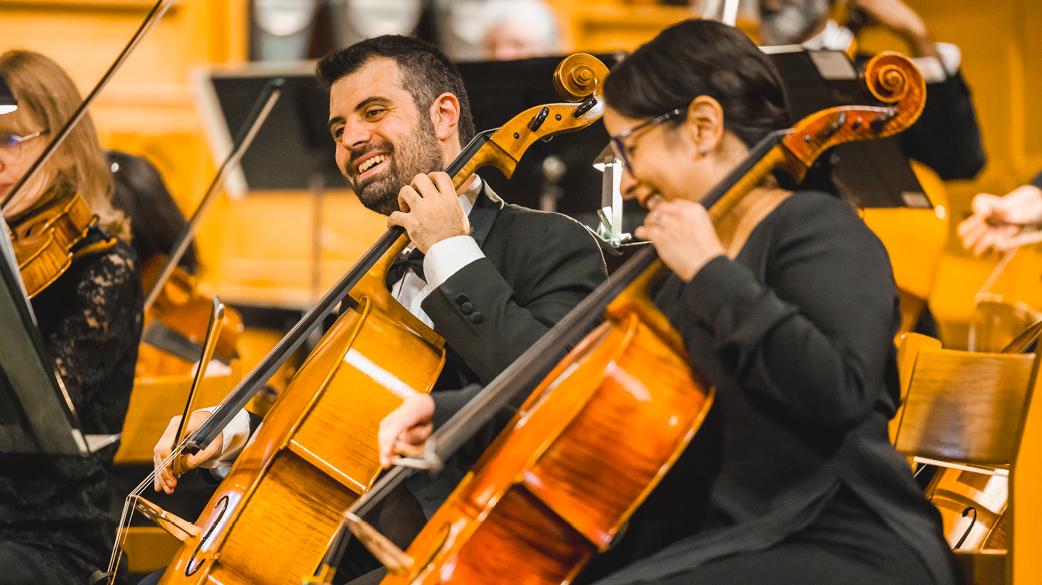
First on the spring to-do list? Throw open the door and let in the breeze.
In Mississippi Symphony Orchestra’s “Spring Delights” chamber concert, the music riding in on that breeze carries all the right sentiments of the season.
The charm of street entertainment, the yearn of nostalgia, the convivial spirit of folk celebrations and the sap-rising vigor that pulls us outdoors – these are the connective threads that make springtime, and this concert, such a joy.
Igor Stravinsky’s Pulcinella at the evening’s outset builds on the commedia dell’arte traditions honed in Italy’s early improv theater and its baroque music. Stravinsky’s suite, composed for Sergei Diaghilev’s Ballet Russes, wraps in his own taut rhythms, sharp edges and orchestral color, giving it some zing and sting to meet the moment in 1920.
Haydn’s Symphony No. 82, nicknamed “The Bear,” calls to mind dancing bears in its lumbering bass and sonorous, rustic appeal to close out the evening with witty and vivacious charm. Listen to this 1786 gem in a spring-fever state of mind and it’s easy to hear the fanfare enthusiasm we feel for the season (especially after this winter!), the pert loveliness of its early blooms, and all the winning charms and playful slant of the rest. It’s just full of lip-smacking joy – come to think of it, that same feeling a hibernating bear might feel, basking in sunshine comfort after his first post-cave feast of the season.
In-between, greet the orchestral premiere of Ecuadorian composer Emilio Villacis’ From a Brother to the World, winner of the second annual International Composition Competition hosted by MSO’s Premier Orchestral Institute. The piece had its world premiere last summer in a performance by POI’s Master Camerata, its top strings ensemble. “It was a dream… one of the happiest moments of that year,” Villacis recalled.
Now, he’s revised the work for full orchestra, especially for MSO players and this occasion. “Now, this remake finally gets the ultimate form as an orchestral piece,” he said.
The composition contest and this performance are part of MSO’s outreach and support for emerging voices and new repertoire. It’s about relevance and resonance, MSO Conductor and Music Director Crafton Beck said. “The new music being written today is so good. These young people are writing music which resonates with all of us and especially their peers.… It’s just very accessible and beautiful music.”
It reflects our society and world in a way that works by composers from previous centuries can’t, because things were so different back then. Beck said, “My job is to fuse the two, to find a way to put the two things side by side, to perform music of 100 and 200 years ago, side by side with the new music in a way that the one informs the other.” Listen for it in “Spring Delights.”
Villacis’ work has roots in a consoling piece he wrote for a friend who had experienced an important loss. Later, for a contest, he developed its emotional theme into a symphony inspired by his family, with movements for his mother, father and brother. “Maybe it was good, but not good enough,” he said. The POI competition brought a chance to refocus on its second movement, the one for his brother.
“At the time, I was living in the Middle East, working there for a few years,” he said, “That nostalgic feeling made me rethink the whole thing.” His home and home country were eight to 10 hours away, as was his older brother, Felipe. He missed it all. New emotions, new experiences flooded in, and From a Brother to the World is the culmination.
“It’s a letter to my brother. We were far away, but we were going to love each other and support each other no matter what,” Villacis said. “Obviously, I added things I knew he would enjoy.” Felipe is not a big fan of classical music, with tastes that slant more to pop. The piece has little shoutouts meant just for him, including a chord from Game of Thrones and sounds reminiscent of folk celebrations back home.
“That’s the informal part of a very academic work,” he said fondly. “You need to show off techniques… but at the end, it’s meant to be heard, meant to be enjoyed, just for common folks. Just like a celebration.
“It’s not just elite music. It’s popular music as well.”