
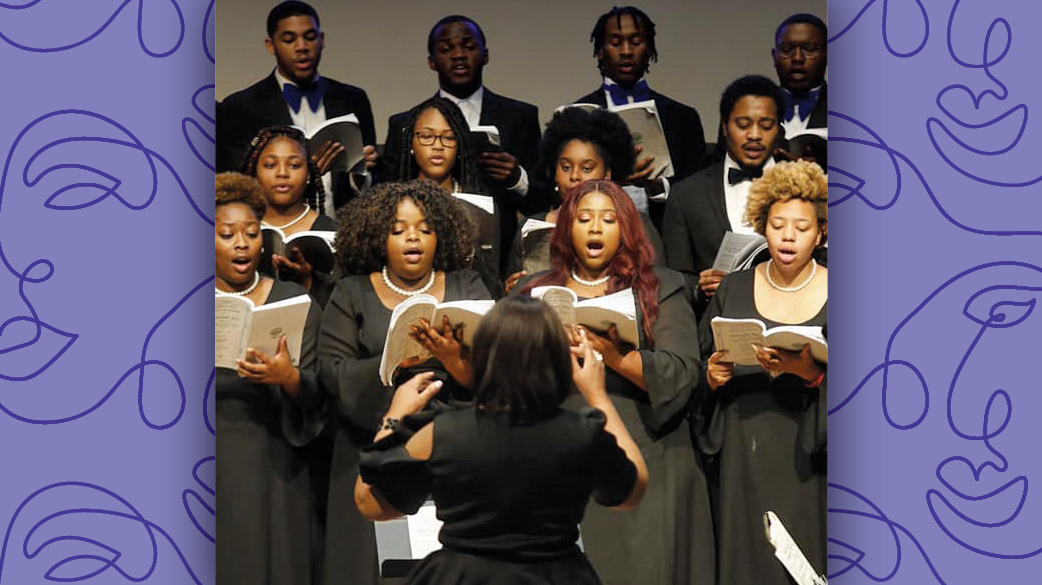
“Nonstop” is how Jackson State University Director of Chorale Activities Harry Cecil described first-semester JSU Chorale rehearsals for Mississippi Symphony Orchestra’s January 24 concert “Transcendent Voices.”
MSO positions JSU’s top vocal ensemble to unfold the heart of the evening’s program through the intertwining of Joel Thompson’s acclaimed Seven Last Words of the Unarmed (2015) and Gabriel Fauré’s Requiem (1888). The concert’s opening, with Richard Wagner’s Prelude to Act 1 of Parsifal and MSO Conductor Crafton Beck’s composition Passage, introduces the evening’s transformational themes.
The JSU Chorale has performed with the Mississippi Symphony Orchestra before, in company with other ensembles, but the sole choir position in this performance brings a particular thrill. “It’s a great honor and I feel like this puts us at another level,” said Cecil.
The ensemble of about 50 men and women includes mostly undergraduates ages 18 to 22, both music and non-music majors, plus a few graduate students who amplify its ranks.
Sought-after international baritone Kenneth Overton of New York City, a Grammy Award winner, is a guest soloist featured in both works with the Chorale. Cincinnati-based soprano Maren Hrivnak, granddaughter of Millsaps College music faculty emeriti Tim and Cheryl Coker, is featured in Requiem. “She is the perfect voice for this solo – the voice of an angel,” said Beck.
In “Transcendent Voices,” Beck weaves together Thompson’s and Fauré’s works, following a movement from one with a movement from the other in a musical conversation, for an impact stronger than the separate works might have on their own.
“We’ve created a musical dialogue between a contemporary voicing of tragic losses and a traditional liturgical expression that seeks “eternal rest” for the departed and their families,” said Beck. “Both build bridges of empathy for the suffering.”
“Really brilliant,” said Cecil of Beck’s merging of the two multi-movement works. It’s also a lot of repertoire – seven movements of Seven Last Words of the Unarmed and seven movements [six for choir] of Requiem. “So, the students were working aggressively… to get all 13 of these movements learned before we got off for [holiday] break. I really have to applaud them,” Cecil remarked, because they still had regular fall and winter responsibilities and performances.
It couldn’t have been easy, particularly with the emotional toll a piece like Seven Last Words of the Unarmed can exact. Using the format in Haydn’s The Seven Last Words of Christ for structure, Thompson set the last words of seven unarmed Black men killed by police or authority figures to a range of musical styles. The composition and the men’s quotes hold the weight of the stories of Kenneth Chamberlain, Trayvon Martin, Michael Brown, Eric Garner and more. Their words, from Chamberlain’s “Officers, why do you have your guns out?” and Garner’s “I can’t breathe!” to Amadou Diallo’s “Mom, I’m going to college” are haunting reminders of those headlines.
“All seven of them were unarmed and regardless of what was the provocation, regardless of what the encounter was, all of them, by the end of the encounter with the police, were dead,” Cecil said. The men’s ages varied, but Martin was 17. “I have teens in my choir who look like him and share experiences … and have similar backgrounds.
“Typically, when we’re singing music, it’s easy to separate yourself from the repertoire, separate yourself from the story,” he said. “Even if it’s a true story, you can even interpret it as fiction because it’s not really happening to you, or doesn’t connect to your life or your background,” he said. “But that was something that was impossible for our students. Not this time.”
These are contemporary stories, contemporary tragedies that students have not just musical knowledge of, but often memory, too. “It was really, really challenging to try to introduce this music in a way that they could move forward and get engaged in it artistically, but not so much that it just kind of took them out,” Cecil said.
“I did know we couldn’t just sing it like any old song.”
He noted composer Thompson’s brilliance, in the connection between the musical style of each movement and circumstances in each death. “Once the students were reminded of the stories, they can hear what Joel Thompson was trying to get across in the movements, and it made some really, really good conversation,” Cecil said.
Merging this somber, masterful work with Fauré’s Requiem, celebrated for its intentionally peaceful, restful nature, brings out the depth of Thompson’s work and shines light on the humanity of each soul that was lost.
“I think Crafton cleverly married these two pieces together to give a sort of balm, so to speak,” Cecil said.
The structure offers time and space for reflection, for consideration, for mourning and solace. The ending, with Requiem’s beautiful Paradisum, is like a prayer for the fallen.